Tai Chi Classes in Shefford will be cancelled on Sunday 30 August, and Monday 31 August – enjoy your Bank Holiday – I look forward to seeing you all in September!
Summer dinner and social
05/06/2026The value is in the journey
14/04/2026
After a few years of Tai Chi practice you may find it takes on a slightly larger place in your life than many personal activities and that is a very good thing. The initial driver may be for balance and mobility but ultimately it is a practice that can grow as a life skill – where the end result is simply a result of the skill set gained through physical practice and engagement of your mental and emotional self.
The value in fact lies in the journey. After all it is great to have good martial ability into later life – but other than earning a living from teaching surely the greater value lies in achieving a balanced and happy life. A result which is possible for all of us through our study and practice – especially including our conversations with others on the same path.
Well, I said that a lot has been going on, so here is some more of it.
If you have read much of my other writing, you may already understand that I have been fascinated for a long time with the implications of martial arts in general and Tai Chi in particular, on the way we view and live our lives in general.
Now that I have recently turned 74 my conclusion so far is that developmentally and philosophically it boils down to having a clear view of reality, which requires a wide range of understanding from Buddhism and Taoism through psycology and biosciences. Perhaps the key being to seek congruence and a measure of structure in chaos.
The connection is in the chaotic and deceptive nature of power based human interactions. An understanding of Tai Chi offers insights and perspectives that are only available when a human being is fully emboddied and aware – which is what we seek. Essentially it involves creating a Tai Chi Life Balance within ourselves mentally, physically and emotionally.
What has been going on?
09/04/2026
It was pointed out to me that I have not posted for quite a long time – which is interesting since a lot has been going on for me in my training – but it has been moving so fast in my body/subconscious that I have not been able to sort it out intellectually and put it in writing!
So now that some at least has consolidated, let me try to put down a few thoughts.
I have aquired more flexible ankles and with them much better balance – also more relaxed groin muscles allowing easier and lower movement.
I took literally Master Chen’s direction to focus on my centre and very physically investigated how this worked. With time I managed to reduce the movement to a rolling feeling and have a much better feeling of connection.
Along with this I have had physical injuries and medical problems which have also provided opportunities to further my awarenes of body feelings, and I can now practice better than before the problems arose.
So how did I do these things, what is the secret? What I have done, and can now suggest, is to investigate your body and its feelings in movement, with awareness, noting the guidance of those that have gone before – your teacher or other masters.
And what is next? Well I am quite a way into eliminating my beginners errors from a long time ago, which came about from too slavish adherance to instruction. Also I am now working on the applications of what I have learned – for example in push hands.
It is worth mentioning as well that I am working regularly with a dance therapist on physical/emotional issues – after 74 years you can imagine that there are quite a few! I am looking forward to my next cycle of development.
Easter Classes cancelled 5th and 6th April
10/03/2026An early Merry Christmas!
14/11/2025
When we mention Tai Chi what do we think of? For most non practitioners I guess it has something to do with TV programs showing exercises in a park – or maybe some strenuous video shorts on social media like Youtube.
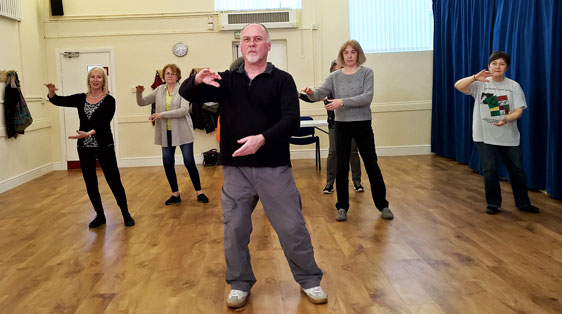 So Tai Chi can be seen in many lights – for myself it simply offers a pathway to a more balanced life – which means different things to different people at different stages in their lives. The exercises and the philosophies behind them cover the whole warf and weft of life if one only cares to explore them – weekly classes are one way to access this in a social environment.
Please see elsewhere on my website for links and articles that can inform this approach
Christmas dinner and excellent videos
11/11/2025Christmas dinner will be on Dec 12th at the usual place – 7.00 for 7.30 pm
A couple of excellent videos: